
Cricket Guides · 5 min read · English
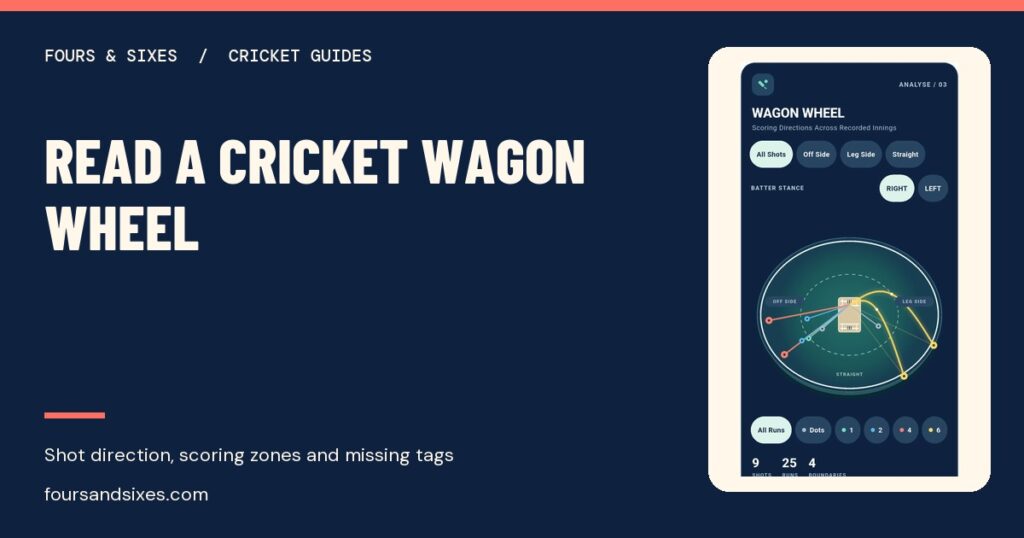
A cricket wagon wheel is a field diagram of a batter’s recorded scoring shots. Each mark shows a direction and a run value, helping you see where the batter found runs around the ground. It is useful for describing an innings, but it does not show where the bowler pitched the ball or explain by itself why a shot succeeded.
On This Page
- What the Marks Show
- Read It Alongside the Scorecard
- Look for Patterns, Then Check the Context
- A Wagon Wheel Is Not a Pitch Map
- What Fours & Sixes Records
- Related Guides
What the Marks Show
The diagram is drawn from the batter’s end. Lines radiate from the centre towards fielding areas such as cover, point, mid-wicket, fine leg and long-off. A scoring shot is plotted in the zone selected by the scorer. Colours, line lengths and labels vary between scorecards, so read the key printed beside the chart before interpreting it.
A wagon wheel is a record of shot direction, not a precise tracking system. In Fours & Sixes the saved shot tag identifies a field zone; it does not claim the ball landed at an exact point on the boundary. Some broadcast graphics show more detailed tracking, but a scorecard should be read according to the data it actually collected. The Queensland Scorers Association describes the chart as a way to show where a batter scored, based on notations made while scoring (wagon-wheel guide).
Read It Alongside the Scorecard
Start with the innings total and the batter’s runs and balls faced. Then compare the total with the number of strokes shown on the wheel. A scorecard includes every recorded delivery, while a wheel can include only shots whose direction was tagged. If the figures do not cover the same set of balls, that is a data-coverage difference, not necessarily a scoring error.
For example, imagine a batter finishes on 42 from 28 balls. The scorer tagged direction on 13 scoring shots, which together account for 36 batter-runs: four fours, two sixes, six singles and one double. The wheel shows that most of those tagged marks went through the leg side. It does not account for the remaining six runs or the 15 other balls unless their directions were also recorded. This example illustrates the reading method; it is not a Fours & Sixes match record.
To understand the full innings, pair the image with the batting line, over-by-over record and match situation. The cricket scorecard guide explains how to read those figures together. A wheel gives spatial context; it does not replace the scorecard’s totals or the match narrative.
Look for Patterns, Then Check the Context
Ask a few simple questions:
- Are the recorded scoring shots concentrated in one zone or spread across the field?
- Which zones contain the boundaries, and which contain singles and twos?
- Does the chart cover most of the innings, or only a small tagged sample?
- Was the batter facing pace or spin, chasing a target, or batting at a particular stage?
These questions can help describe what happened. They cannot establish that a batter has a permanent strength or weakness. A chart from one short innings may look very different from one built from several matches. The opposition, field settings, pitch, innings phase and untagged deliveries all matter. Compare the chart with the rest of the match record and avoid treating one graphic as a verdict on a player.
The same caution applies when comparing two players. Make sure both wheels cover a similar number of recorded shots and comparable match situations. If one batter has 40 tagged shots and another has five, the second wheel is a much thinner sample. For broader scorecard measures, see the guide to batting average and strike rate.
A Wagon Wheel Is Not a Pitch Map
A wagon wheel plots where the batter played or directed scoring shots. A pitch map plots the bowler’s delivery location or line and length. They answer different questions. Use a wheel to review shot directions and scoring zones; use a pitch map, when a match has one, to examine where deliveries landed. Do not infer a bowler’s line or length from a batter’s wagon wheel.
Also check the chart’s orientation. A right-handed and left-handed batter face the field differently. Some diagrams rotate the field to match the batter’s stance; others keep a fixed ground orientation. The label or key should tell you which view you are seeing. Without that information, avoid describing a mark as “off side” or “leg side” with certainty.
What Fours & Sixes Records
The public Match Centre can show the shot map for a shared match. Fours & Sixes also has career and innings Wagon Wheel analysis in Pro. Those views include only deliveries with a saved shot direction; the chart does not fill in missing directions. See Match Centre features and player analysis for the current product details.
Use a wagon wheel as one view of a recorded innings: check its key, note how much data it includes, and return to the scorecard before drawing conclusions.