
Cricket Guides · 5 min read · English
A cricket points table summarises each team’s completed results under a competition’s published rules. Fixtures show who plays whom and when. To organise a competition fairly, decide the format, points for each result and tie-break order before the first match; then make sure every result is linked to the correct fixture.
On This Page
- Start With the Format
- Publish the Points Policy
- Work Through a Four-Team Example
- Keep the Table Connected to Its Fixtures
- What Fours & Sixes Provides
- Related Guides
Start With the Format
In a single round-robin league, every team plays every other team once. With n teams, the number of matches is n × (n − 1) ÷ 2. Six teams therefore need 6 × 5 ÷ 2 = 15 matches. If every pair plays twice, once at each home venue, the total doubles to 30.
When the team count is odd, one team has a bye in each round. With five teams, a single round robin has 5 × 4 ÷ 2 = 10 matches. You can arrange five rounds with two fixtures per round and one team sitting out each round. Rotate the bye so every team receives one. A bye is a scheduled rest; it is not a win and should not earn win points unless the competition rules explicitly say otherwise.
For a small knockout, a team is eliminated after a loss, so the number and placement of byes matter when the entries do not fill a complete bracket. In a groups-then-knockout format, publish how many teams advance from each group and how the semi-finals are seeded. Whatever the format, share the fixture list and explain how postponements, abandoned games and withdrawals are handled.
Publish the Points Policy
There is no universal cricket points table. A competition may award different points for wins, ties, no-results or bonus achievements. Choose and publish a policy before play begins. A simple illustrative policy is:
| Result | Example points |
|---|---|
| Win | 2 |
| Tie | 1 to each team |
| No result | 1 to each team |
| Loss | 0 |
These values are an example only. Some competitions use other point totals, award no points for a no-result, or include bonus points. For a no-result, define whether points are shared and whether any statistics count towards tie-breakers. Avoid changing the policy mid-tournament to suit a result.
Work Through a Four-Team Example
Suppose four teams play one round robin. The six results are: A beat B 150–130; A beat C 170–150; D beat A 165–160; B beat C 140–135; B beat D 155–145; and C beat D 145–140. Under the example policy, the table by points is:
| Team | Played | Won | Lost | Points |
|---|---|---|---|---|
| A | 3 | 2 | 1 | 4 |
| B | 3 | 2 | 1 | 4 |
| D | 3 | 1 | 2 | 2 |
| C | 3 | 0 | 3 | 0 |
A and B are level on points, so the tie-break policy decides their order. One common limited-overs measure is net run rate (NRR), which compares a team’s scoring rate with the rate at which it conceded runs across the competition. If every innings in this example lasted 20 overs, A scored 480 runs and conceded 445: 480 ÷ 60 − 445 ÷ 60 = +0.583. B scored 425 and conceded 430: 425 ÷ 60 − 430 ÷ 60 = −0.083. If the published policy ranks by points and then NRR, A is ahead. This arithmetic is illustrative; the competition’s conditions determine how overs and exceptional results are counted.
Before the tournament, write the exact tie-break sequence—for example: points, then NRR, then head-to-head result, then a designated deciding match or other published method. If head-to-head comes before NRR, teams may finish in a different order. Official ODI conditions provide one example of a points and NRR system, including special treatment of an all-out innings and DLS results; those conditions are not a universal club policy (ICC ODI result conditions).
Keep the Table Connected to Its Fixtures
After a match, verify the two teams, result, innings totals and completion status against the fixture. Record any tie, abandoned match or revised target according to the rules that were agreed. Then check that the points table reflects the result and that any tie-break calculation uses the correct competition data. A table that looks surprising is a reason to review the underlying fixtures and scorecards, not to edit points by hand until the order looks right.
In a standard limited-overs NRR calculation, teams use runs scored and conceded across the competition, not the average of each match’s NRR. Cricket overs are groups of six legal balls: 18.4 overs means 18 overs and four balls, or 112 balls, not 18.4 decimal overs. If a team is all out before its full quota, the competition may require the full quota to be used in its NRR calculation. Rain-affected results can also have specific treatment. Check the applicable competition conditions before calculating, and see the separate NRR guide and NRR calculator. Do not assume a general calculator has applied a local DLS adjustment.
What Fours & Sixes Provides
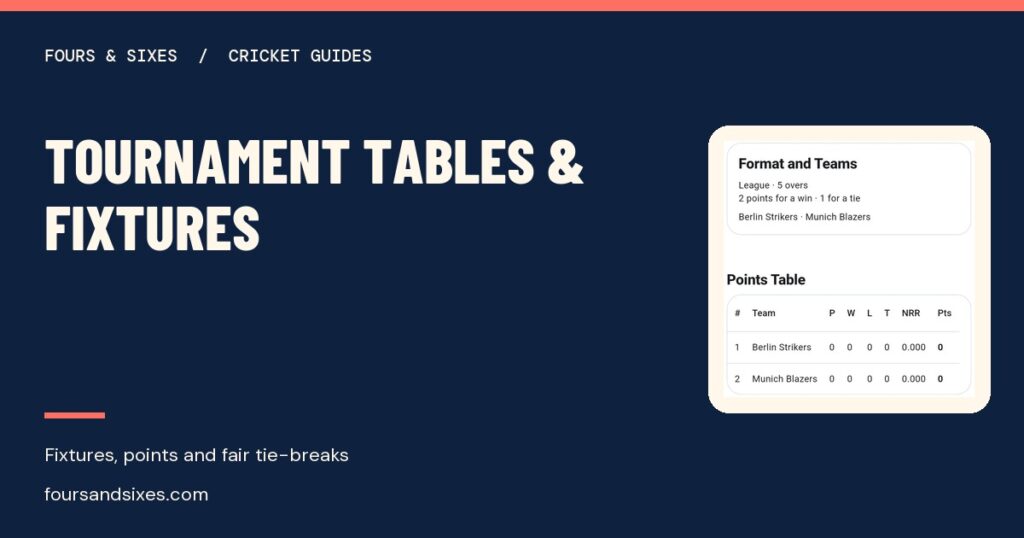
Fours & Sixes can create league, knockout and group formats, generate fixtures, record schedules and results, and show standings. The tournament setup lets the organiser set points for wins and ties. Link each completed match to its fixture so the table has the right context. The app’s displayed NRR should be checked against the tournament’s published conditions for special cases such as all-out innings or rain adjustments.
The existing guide to keeping tournament records connected covers team identity and linking matches to a competition. This article focuses on fixture mathematics, points and tie-break rules. See Tournament features for the app workflow. For rules about recording an individual delivery, see how to score cricket extras.